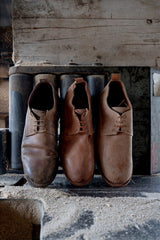


Orlando 1837 - Full Grain


About Our Try-On Service
The Try-On Service is available for customers within Japan only.
For items labeled "Try-On Available" on the product page, we offer a service that allows you to try them on at home before deciding to keep them. If the size or fit isn't right, you may request a return or size exchange.
Please read the following guidelines carefully before using this service.
How It Works
- Add the item you wish to try on to your cart as usual.
- In the Order Notes section, write "Try-On Request".

- Proceed to checkout and complete your purchase.
- Once your order arrives, please try on the item indoors only.
- If you wish to return or exchange the item, contact us via email (email.loungesai@gmail.com) within 3 days of receiving your order.
- For returns, please ensure the item is in its original condition — including all tags, packaging, and accessories — and send it to the return address we provide via email.
Please note: Return shipping costs are the customer’s responsibility.
Return & Exchange Policy
Items eligible for return or exchange must meet the following conditions:
- The Try-On Service is available for customers within Japan only.
- You must contact us within 3 days of receiving the item.
- The item must be unworn (except for trying on indoors), and free from stains, odors (including perfume or smoke), damage, or signs of use.
- All original tags, packaging, and accessories must be included and intact.
- Repeated try-ons and returns of the same item may not be accepted.
We are unable to accept returns or exchanges in the following cases:
- Returns sent without prior notice.
- Items that show signs of use, stains, damage, or odors.
- Missing or damaged tags, packaging, or accessories.
- Made-to-order (custom-order) items.
- Non-clothing items such as fragrances or hygiene products.
Once we confirm that the item meets these conditions, we will proceed with a refund or size exchange.
About Resizing
If your item doesn't fit perfectly after trying it on, we also offer custom resizing (alterations).
For example, we can adjust sleeve or hem lengths to better suit your measurements.
Because ready-to-wear sizing may not fit everyone perfectly, we encourage you to consider resizing options to enjoy your item comfortably for years to come.
For more details on resizing, please visit:
→ [About Alterations]
Contact Us
If you have any questions or would like assistance, feel free to reach out via chat or email:
email.loungesai@gmail.com
A Note on Using This Service
Our Try-On Service is designed to help you choose with confidence.
We kindly ask that all items be handled with care during your try-on period.
Thank you for your understanding and cooperation.


- Norwegian welt construction
- Vacchetta full grain leather
- Vibram tank sole
- Made in Italy
Guidi Rosellini
Founded in 1896 in Tuscany, Italy, as the leather tannery Conceria Guidi e Rosellini, it has continued to supply materials to renowned brands around the world, establishing its position as a tannery to this day.
At the time, Tuscany had an inexpensive supply of beef cattle, and the leather of female calves in particular was of high quality and durable, so the company produced work boots for laborers and hunters.
Guidi Rosellini is the collection that revives the designs and construction of those shoes for the present day.


Guidi Rosellini, a revival of classic work boots.
Guidi is a brand widely recognized within the so-called "artisan" footwear world, known for its many iconic models such as the back-zip 988 and the front-zip PL1.
On the other hand, despite sharing the same "Guidi" name, there are quite a few people who have never even heard of Guidi Rosellini.
Guidi Rosellini is a revival line born from the personal passion of the president of Guidi. Because of that, the vacchetta leather (female calf leather) used exclusively for Guidi Rosellini is considered the highest-grade leather produced by the company.
Its iconic natural color and the use of Vibram tank soles on all models set it apart, offering a completely different approach compared to Guidi's main footwear collection.
With a history rooted in crafting work boots, Guidi Rosellini continues to produce work-inspired footwear such as the Ruggero 1906 and Morosino 1907.
The Orlando 1837, on the other hand, is a Tyrolean shoe — traditionally said to have been used for hunting and mountaineering in alpine regions.


Vacchetta Leather
Unlike the Morosino and Ruggero, which use reverse leather, the Orlando features full-grain leather. Guidi’s vegetable-tanned vacchetta leather is known for its rich oil content, becoming softer with wear and developing a remarkable patina over time.
The dark brown Orlando shown in the photos is my personal pair, purchased new in 2020 in the same natural full-grain leather, and still worn today.
In my case, rather than carefully maintaining them, I’ve done quite the opposite — wearing them without concern in rain and snow, and only occasionally applying a bit of cream for minimal care.
A sales representative from Guidi once told me, "The moment you see Vibram tank soles on them, you know what kind of boots these are," and mentioned that she has been wearing her Ruggero boots for over seven years without any care, even taking them hiking and wearing them through rain and snow.
If, like me, you prefer a darker brown tone, applying oil or cream will deepen the color relatively quickly. On the other hand, if you want to enjoy the natural color as it is, you can simply wear them without any maintenance.
This is the appeal of the natural color — a leather that offers a truly one-of-a-kind aging process, shaped by how each person chooses to wear and live with them.
Current models come with a dedicated Guidi Rosellini care cream, so you can simply use that for maintenance.
Also, over long periods of wear, the leather laces may eventually break. However, if this happens within one year of purchase, replacement laces can be ordered free of charge as part of our after-sales service (shipping from Italy billed separately; from the second year, replacements are paid).
In addition, fabric laces are included, so you can swap them in to suit your preference, or wear the shoes with them while waiting for replacement leather laces to arrive.


Timeless design — and that’s what I wanted.
The only Norwegian welt in the Guidi Rosellini line, this construction runs two rows of stitching along the welt and is said to offer durability and water resistance, requiring considerable effort and skill.
The soles can be replaced, so these are shoes you can keep for 10 or even 20 years.
Incidentally, while cork is usually placed between the insole and the outsole, Guidi Rosellini uses leather instead of cork, one more sign of its commitment as a "leather specialist."
As a result, the leather of the sole gradually conforms to the shape of your foot as you keep wearing them.
The last is different from those of the Morosino and Ruggero, and the Tyrolean shoe itself is a style not found in Guidi's lineup.
Leather shoes are often in dark colors such as black, so the natural color may look unfamiliar at first, but natural also pairs very well with dark clothing such as black.
Customers who tried them on at our pop-up event were surprised at how easy they are to match, and it was memorable to see them reassured.
Compared with the Morosino and Ruggero, the Orlando is more casual and suits relaxed, effortless styling.
Of course, it is not only dark colors; needless to say, it also goes outstandingly well with denim.
The way these shoes age — becoming more beautiful with every crease, scratch, and stain — is of course part of their undeniable charm. But beyond that, it's the timeless design, unchanged from the days when Guidi was making work boots, that continues to make them a piece you want to keep wearing.
No matter how your style or taste in clothing may evolve, these are shoes you can continue to wear. The fact that I’ve been wearing mine regularly for over four and a half years is proof enough of that. And I know I’ll keep wearing them for many more years to come.